Tuesday, May 22, 2012

Movie "Sucker Punch" ridden with Illuminati mind control symbolism.


Yesterday I read an article my girlfriend showed me about a movie she saw which someone on YouTube pointed out subliminally alluded to the Illuminati's MKUltra Monarch Mind Control. She gave the article a read-over and I did too, and decided it was worthy enough to dedicate a full blog post to.

Here's the link: http://vigilantcitizen.com/moviesandtv/sucker-punch-or-how-to-make-monarch-mind-control-sexy-7-2/

I may place a new focus on the concept of drawn-out explanations of full shows', movies', games', companies' and industries' Illuminati-symbolic meanings. Many of these findings will also be routed to Complete List of Illuminati Symbolism when I find time.

Thanks for reading.

Saturday, May 19, 2012

What love is, exactly.

Anarchy's about love and peace. Not chaos, destruction and hate.

I'm going to explain quickly and concisely in this post what love is, to the best of my holistic understanding.

Understanding love is fundamentally going to require a holistic perspective, or at least an open mind. This is actually considered 'lunatic fringe' by those who don't give it a proper chance or interpret it right. But in my experience, those who gave it reasonable listen admit it's more sane and logical than ordinary explanations for it coming from either religion or science.


Through others' ideas and experiences, the findings in quantum physics, speeches from David Icke and Bill Hicks, near-death experiences (NDEs), logical deduction, and the whole-minded observance of my emotions and others' over several years, I've concluded there's only two emotions we ever really feel - fear and love. Apathy sits neutrally between them, while all other emotions derive from those two polarities more or less - anger, hatred, jealousy, greed, impatience and sadness being fear-derivatives, each being a fear of something different. Meanwhile, happiness, joy, bliss, tranquility, kindness and general feelings of peace are love-derivatives. What separates anger from hatred would be the way in which those forms of fear are expressed, just as someone can be joyously blissful as opposed to simply being meditatively tranquil, both being forms of the same love, just... expressed differently. If you're reading this post from 'What is love, anyway?'... doesn't that sound familiar?

You wouldn't know it if you didn't observe your own feelings intently as I and many others of this understanding have, watching how they rise and fall in response to various thoughts and other stimuli. Emotions work on a wavelength, love being the higher frequency with more energy, and apparently affects DNA directly by uncoiling it and activating more genes which are otherwise shut off along with a degree of our mental capacity when we experience fear in any of its various forms - hence the idea that only 5% of our DNA is scientifically-reported to be 'useful' while only 10% of our brains' capacities are typically used on a daily basis. There's room to expand, and conscious focus and wavelength is how to unlock the rest. Surely, you've wondered, like me, why we can't seem access the full brain, or all the memories it supposedly stores in subconscious.

Fear only describes the absence of love - just as darkness is the absence of light, and cold is the absence of heat. Everything works on a duality - presences and absences. In a way, you could say love (including its derivatives) is the only true emotion we experience.

Purpose of life? Unconditional love. "How am I supposed to love if I don't know what it is exactly?" Love is everything that feels right. Love is your conscience, kindness, and acceptance - while fear is rejection. To accept what comes to you in life is to love; to reject it is a characteristic of being afraid - each fear-derivative emotion being a fear of something different. There are different ways of expressing love - it's not always as simple as running outside and giving away all of it to everyone. In a perfect world, we could easily do it like that, but this is a world where we have to go through fear and left-brained mechanics to somehow get a loving, right-brained message across to people to bring them up out of a materialistic prison as part of the human experience. An example would be, say... music. I'm a rap artist too.

Moreover, love is actually the energy that forms what we are - consciousness. Consciousness is not only the ability to be aware, but it synonymously describes the range of emotional frequency on which we exist. Lower wavelengths (fear) cause us to feel retracted with a narrowed perception. I'm sure you can recall moments when you experienced negative emotions and couldn't seem to do anything right or think straight, while in moments of positive emotion you seemed to be capable of things you never thought you could do, or your 'luck' just seemed to always play in your favor. This is because what we call 'God', or 'the source', or 'collective consciousness' as you may've heard it called, is actually what we are, and so we create reality around us just by the very weight of our own emotional intentions. God is consciousness, which is basically love, and love's the energy of creation, which also means we're creation itself. We individually have the capacity to alter reality through the intentions we generate through free will, generated by consciousness, which is raised by the wavelength of our emotions, which is raised by the wavelength of our intentions, generated by free will which expands with greater consciousness, and so forth, progressing up/down the 'spiral staircase' as I refer to it.

That was a complicated garbled bit, to let me graph it out simply for you to understand.


Creation, which is formed by consciousness, which is what 'God' is, in the simplest explanation. In other words, we are consciousness, therefore we are God, therefore we are creation - meaning, we are in everything. If you've ever heard the phrases, "God is in everything," and "We are one," and "We are all part of a collective consciousness or pool of knowledge," these apply fully to what I'm describing here.

This has nothing to do with the scrambled version of 'God' in religious texts, although the basic ideas remain true - infinitely, eternally, unconditionally loving, accepting and forgiving.

Spiral Staircase EffectConsciousness » Free Will » Intent » Emotions » Consciousness... (Repeat)

...We are consciousness (God). From that, we become aware, and thus can produce the choice to intend. We can have loving or fearful intentions, which variably cause our emotions to flux into fear or love. As our emotional wavelength fluctuates, our consciousness becomes more open or closed, depending on the emotion. As our consciousness opens up (from loving intentions producing loving emotions,) we have a wider array of choices to make from free will, which gives us a greater capacity for intention, which causes a greater effect on emotions, opening our consciousness up more.

LoveHappiness, joy, bliss, tranquility, peace, serenity, harmony, love                      
FearAnger, hatred, sadness, depression, anxiety, hostility, impatience, greed, fear


What I'm telling you here has everything to do with the feeling in this picture.
I make it sound absurdly simple, but the reality is... it can be as complex as you wish to make it. Complexity's beautiful too. I've heard people argue, "Emotions aren't as black-and-white as just fear and love." I understand their viewpoint, but they're not 'getting it'. 'Emotions' aren't just as simple as 'emotions' - there's also fear and love, and from there we have everything those two break down to and different expressions of each. Quite complicated indeed when you get past the semantic barriers like the simple word 'emotion', or 'love', or 'fear'. Those are just words. What they stand for... is much more.

The Law of Attraction doesn't dictate opposites attract - it's referring to the fact that the wavelength of intent you project influences the energy wavelength of everything around you, causing that which you project to return to you in similar form... otherwise known as 'karma'. 'Karma' isn't a nebulous rule created to punish or reward people for raw actions. It's an actual, logical system of science meeting spirituality explaining how reality works. Pertaining to the energy we give off, you've probably heard of people who can feel energy off others, like an aura, or maybe at times you've felt a negative or positive vibe off someone with no apparent physical explanation for it. That's also part of this, but that involves you doing your part and being open enough to receive that energy and understand it.

A lot of people say, "The Law of Attraction's bullshit. My thoughts haven't affected any-fucking-thing in my life at all." Because your thoughts are just electrical impulses in the brain. It's not an integral part of who you fundamentally are, which is consciousness, creation, God, and love. Those four, being synonymous, refer to your capability to be aware, produce free choices, make intentions, and feel emotions - those are all part of the fundamental existence transcending this illusory reality, and because of that, they allow you to do such things as influence the energy which forms the illusory physical reality around you. Thoughts, on the other hand, are only a part of that illusory reality.

Think of yourself as a programmer. The computer can only do what it's programmed to do within its code's contained limitations. You, meanwhile, are outside of those limitations - and you can alter those limitations, thus.

Know something here: this is spirituality, not religion. (The difference between religion and spirituality...) I suspect there's truth in religious texts, but it's not as we commonly perceive it, which is the part I'm calling bullshit on. Nobody judges you but you. I'll bet if you looked within yourself now, you'll find an indignant outcry to the idea that some deity should tell you who you are and decide how you should be. I struggled with that too often myself until years of experience and searching started coming together over months to begin making sense to me.

It always bothered me to see people say - especially right to my face - that nobody in the world understands love or knows what it is. Even the people who've felt true, unconditional love. "Nobody gets it, nobody will." Seven billion human beings on this planet from massively variable walks of life, and an average Harrisonburg college alcoholic's telling me nobody in the world understands. Sometimes, I'm not proud to be human...

For most people, many of their own thoughts don't really belong to them. Much of what we think we know is only echoed from what someone else reflected on us from another source, usually tracing back to some form of mainstream media. That's how we're raised. We're brought up to obediently accept what we're taught without question, which is astonishingly, and... not coincidentally via left-brained indoctrination. Most think it's an accident; I'm a proponent of the stance supporting it's deliberate. Nearly all of what we're taught in school, if not everything outright, is taught on the basis of, "This exists because we can perceive it physically." It's not the teachers' faults, it's the big guns running the public education system, which traces back to our government, which sits in the back pockets of a few large companies and ultrawealthy families who have something to gain out of manipulating the very habitual thought process of each human being in the country, continent, and even the world.

Click to enlarge and read the descriptions of both sides.
Because of this left-brain focus, we're narrowed out of right-brain understanding, which shuts us down to our spiritual, emotional, artistic side, that part of us that allows us to feel true happiness, and laugh, love, and feel inspired. These don't originate in the brain itself, but the right brain is specifically-purposed to process this type of informational input from conscious intent while we're manifested in these bodies.

And because of this mental trend, few understand spirituality, God, emotions, or... love.

"But scientists discovered the chemical formula for love, so everything you're telling us has to be false..." It's not unreasonable to think chemicals are what cause our emotions, but it's actually the reverse - our emotions cause the chemicals. The signals are sent from the spirit to the body which it's connected, which allows us to manifest and consciously perceive while in these bodies. The body reacts to those signals and their frequencies by releasing chemicals and opening or closing genes, and other various reactions. Take for instance, anger. Being angry sends a particular signal to the body which, after processing through the brain, manifests as increased blood pressure and muscle tension, which leads to things like a red face, shaking-with-anger, furrowed eyebrows, and such.

I'm convinced emotions aren't a part of the body because they seem to function completely independent of it while always directly related to my consciousness, intentions, willpower, and any 'spiritual' experiences I have. I honestly can't recall a moment where my emotions weren't what they were as a result of my own choices - even when, through medicine or other means, my brain's functionality was inhibited. My emotions were never apparently tethered to brain function.

Believe it or not, I go out of my way to prove myself wrong or find any reason to think these theories are inconsistent. After several years, I've yet to find any. But I still look... to be sure.

While the purpose of life may be to unconditionally love, it should be noted love can be expressed any number of ways, including through the career some make for themselves. As a doctor, you may express it through treating and saving lives, as a journalist, you may do it through interviewing others to discover answers for the whole, or as a musician or rap artist, you might express it to inspire and inform others about it. It doesn't have to be simply saying, "I love you."

It is whatever you wish it to be... just love. Unconditionally. But don't suppress negative emotions. They're there for a reason, and they're part of you. Accept them like you'd accept any positive emotion. It may seem plausible to remain within a state of love at all times, but that's not the case. It's just like how you'd positively treat a mistake; instead of getting angry and giving up, you accept it, learn from it, and keep going. That's part of what love's about.

From here, go back to 'What is love, anyway?' and (re-)read that post with the understandings you've made here and see how differently you interpret it then. And those questions, asking how love deprivation can kill someone, or why people commit suicide without it, or how it can cure 'incurable' diseases or prevent injury or illness... start to look less perplexing.

What is love, anyway?


I'm not religious, but this line tells a lot of truth.

People usually say it's synonymous with affection. Scientists say it's a chemical reaction, spiritualists say it's the driving force of existence as the energy of God. Nihilists say it's nothing, while atheists pretend it's something. And certain bitter people out there say it fucking sucks and leaves more hurt than happiness.

It's actually been shown that a person can literally die from love deprivation. It's observed more through infants than anyone else - adults usually commit suicide instead.

Love, in fact, has been shown to cure 'incurable' diseases and prevent illness and injury. Quite a strange thing, isn't it. "It's just chemicals, nothing more. Science has proven it." I'll never understand the drive some have to discover how meaningless everything is. Some revel in these discoveries. But for me, love is much more than a chemical reaction, transcending the physical.

I'm not attempting to tell anyone what their own feelings are, but I feel there's a certain way everything works, and this is probably how it works, in my eyes. Earlier, my dad was trying to tell me earlier there were different types of love. He was saying the love for a friend is different from a girlfriend/boyfriend, or a family member. I was trying to tell him there's only one love, the 'differences' being the expression. The love for my best friend isn't any different from the love for my girlfriend, it's just expressed through different means. I express love for my best friend by doing the things brotherly best friends do, like chilling and talking. I do that with my girlfriend too, and my father, and people I don't even know, but I don't call them 'best friends'. I can also express love with my girlfriend sexually, exclusive to her, but I can express it in any other way without sex if I had or wanted to. The point is, in the end, I love her. Choosing to be her sex partner doesn't suddenly make it a different love any more than deciding to play soccer with a friend I normally videogame with. It's all the same, just a different circuit to achieve expression, the final result.

My dad went on to counter my argument by saying we're affected in different ways by the losses of different loved ones. Losing a simple friend isn't the same as losing a wife - granted. But what he missed was, I can feel more love toward one person than another, and it just happens that spouses are often the closest person we have - that's why it hurts so much more to lose one. I have friends, but my bonds with them vary in strength. Some I hardly give many fucks about, and others I would almost die for. Same relationship, same love... but different priorities. Some husbands have wives they've loved dearly their whole lives, and others have had marriages lasting only hours - but either way, while the love might be expressed the same, it was done so in different amounts. The amount which I love someone isn't a condition of the relationship status.

My dad then asked me what love is.

I'll be simple about what I think. Love is happiness in raw form. Everyone's ultimately after happiness - I'll bet even you are, too. So really, love is just the purpose we all seek to fulfill, and everyone's looking for it. Unfortunately, people look for it in the wrong places, one of the most common reasons being that society equates love with sex, so most people look for it in sexual relationships and ignore what love's really about. In case you haven't noticed, a lot of people have this "Fuck love!" attitude in a world where love is severely misinterpreted and relationships are built strictly on sex resultantly, forsaking the expression of actual love in favor of believing venereal pleasure is where it's at. It's always been my impression these sorts of people are just riding the bandwagon, because anyone who truly sought love would stop themselves in that position and ask if they're really happy.

If you have an open mind and a desire to truly know the mechanics and reality of love, click here. (What love is, exactly.) For everyone else, relax - it'll always be here when you want to know.

Thursday, May 17, 2012

Summing up why I don't agree with atheism.


So why should I believe you suddenly?... Ironic.


Understand that this is not directed at all atheists. I'm aware many of you don't fall into the statements I make here. (That's why I try to say 'most' or 'some' atheists, and not generalize every atheist or say 'all'.) A lot of what's said here can too quickly be taken on a personal level - none of this is aimed personally at anyone for any grudges or with any intent to hurt or belittle. If you know a statement doesn't apply to you, move on and acknowledge it wasn't meant for you. This is meant to be a concise refresher and re-definer of some of the ways we commonly see things. If you think I was wrong somewhere, leave a comment about it - I'm always down to make improvements and admit mistakes. Thanks for reading.

And no, my reasons aren't too different from others' reasons, either. Yes, it'll be the same song and dance everyone else gives, more or less. Just deal with it... Everything'll be alright, you can get back to your Internetz after skimming this over, okay?


Lemme explain a few things first... I'm not religious, but I'm not going to accept I'm just a chemical reaction with a purposeless life either. That's why I think there has to be a 'God', or a spiritual source we return to in death. Otherwise, my evolutionarily-endowed intelligence is going to understand nothing I ever do or feel amounts to anything, which means suicide is in fact the most logical thing for me to do if I concluded that.

I mean, I can't live knowing every single thing I ever attribute or connect to is absolutely pointless. That goes for 'morality' too, I never understood how atheists can use 'morality' against religious-theism when without some ultimate justice or standard for 'good', morality in itself is baseless and moreover useless since in atheism no outcome of any encounter matters anyway, other than through the fabricated perceptions and fears we develop through life - which, ironically, so many people cry out against ("Materialism's bad!") when in fact materialism is, from an atheistic stance, the entire basis of any and all thought, emotion and perception of any form - including unconditional love.

I just don't think people think about this enough outside of religious-theism's little box. Most atheists ended up atheistic because they assumed spirituality as a whole is false... just because one book of fairy-tales was taken too seriously when they were actually looking for truth. (The difference between religion and spirituality...) The reality is, most atheists take the same route of logic religious-theists do... they just arrive at the opposite conclusion. And that's understandable in a world where the only apparent explanation for spirituality we have is religion - but when we see it's bullshit, the immediate logical answer seems to be atheism. And I can't of course ignore the people who were pounded cruelly with religious doctrine by their parents from youth coming up - that sort of shit can be hard to not be bitter at in a non-atheistic respect. Somehow, it isn't as cold when you believe in a God, as if you might indirectly admit they were justified somehow for all your parents or religious leaders did. Well, I'm here to inform you - they never were. Even if they came up under the same treatment.

One thing that kind of bothers me about a lot of atheists, is when they don't find the 'truth' they were after in religious-theistic claims, but then a lot of them turn around and say it's a just a 'business'... Well then why do you use it as a make-or-break for whether there's a God or not when you acknowledge it was never meant to explain the 'truth'?... If in fact you know it's childish bullshit, why do you continue to use the Bible - or any other religious-theistic text - as a reference for truth under any assumption?

Why do you even look for truth anyway? The only reward we all get for any morality or accomplishment is a cold oblivion - and we all receive the same dose and quality as anyone else in the world regardless, if indeed there's nothing to be met in death.

So you're atheist, and everything that exists is eternally purposeless. Now what?
Normally, I'd just live and let live, but quite a few atheists seem intent on shoving their views around on other people like evangelism, so I think I have grounds to stand up and state that I've yet to see any logical support for an atheistic outlook. Usually when you ask them for evidence, they start off by just pointing at the Bible and rambling off Bible verses (exactly like Christians do) and use those as 'evidence' supporting their belief (again, like Christians do.) No actual evidence whatsoever to support their claims other than to lean on fictional books with the hope everyone else will jump that gap of twisted logic to assuming life is hopelessly purposeless and the entire, widespread concept of spirituality is always, utterly, and unquestionably false in all conceivable respects... entirely because a child's book didn't make adult sense.

It's atheists' consistent references to Christianity as the only possible source of 'truth' which alone makes most atheists technical invert-believers to Christianity in the first place, even as atheists. Nevermind a generic concept of 'God', or a 'source', or 'collective consciousness' without religious implications. It's as if spirituality has to have a bullshit religion attached to it in order to exist. (The difference between religion and spirituality...)

That's the thing that leaves me staggering speechless about atheism. It's the absolute, inexcusable stupidity of jumping a logic gap into an illogical conclusion which in fact is just as severe, if not more-so than religious-theism. Most atheists talk about logic, how religious-theism lacks it and that's what makes atheism 'superior'; shit, they're not even making sense themselves. I can't even call that 'ignorance', 'retardation' is closer to what I'm getting out of it.

The other thing that gets me is the idea spirituality and science can't work hand-in-hand, like evolution couldn't be a tool used by God, but in fact can only mean there isn't one. Shouldn't science be opening up the concept of God more, looking for actual flaws in the idea, rather than jumping the gun on assuming science is all that exists? For all the claims that evolution proves there isn't a God, and for all the pointing-fingers outrage at religious-theism, all atheists really end up doing is disproving certain primitive beliefs - but they never disprove the core, generic concept.

More and more, I'm convinced atheism's culturally no longer a simple disbelief in a God, but actually about attacking religious-theism and making full conclusions from partial assumptions to try and construct a complete example for itself. And I'm just saying that not because I myself am attempting to attack atheism, but because if you haven't noticed, atheism's become a big deal, practically a hate belief if you go to the right places, and all I can say is... If you're going to give a reason for yourself, at least make it logical. But until then, atheism's culturally built up to being no better than religious-theism, and I'll say the unthinkable when I mention atheism's in the same barrel as Christianity, Islam, Hinduism, and the rest.

Heathen's progress... that one's an oxymoron, isn't it. Anyway, the message in this picture is a reminder that atheism has its good points - not everything we want to believe is necessarily true.

Then there's atheists trying to justify their stance because they 'unconditionally love' others - after they've gone to measures to minimize the meaning of love itself down to simply no more than a different chemical composition than what could otherwise be vitriolic acid, save an electron or two. You might as well forget your 'unconditional love' for others, since it's only as materialistic as watching TV, and after all, it means nothing in the end, right? Appreciation for life and unconditional love are beautiful... until people are born with serious chemical imbalances and die out their 'one life', forever obliterated, never having appreciated anything - all because of a genetic defect they couldn't help. I don't see the beauty in that.

It always astounded me to see atheists giving God-like qualities to their belief as a means of dismantling religious-theism.

Seems like cultural atheism (as opposed to personal) eats up the fine lines separating reality from illusion, publicly deems the two synonymous, then everyone starts falling into line according to semantic misinterpretation. This is like an information wildfire destroying the solid differences between concepts and conflating them into two ways to describe the same thing. Like how I did with atheism and nihilism? No, not really - I'll tell you the difference between those two right now: atheism only stated there isn't a God... not that life's purposeless. But that's a given. Without a God, we can rule out an afterlife, and without that, where do we go when we inevitably die? It's only logical - in atheism everything ends eventually, and that means everything we live for will be obliterated. So why live for anything at all? That's when you wake up from atheism's illusion of purpose into nihilism's full realization that really, you're fooling yourself if you actually believe you're accomplishing anything at all by raising your children 'right', or with 'loving care'. And all the evolutionary claims of 'survival being our purpose' head for garbage when people start committing suicide from that realization. It backfires on atheism in the end.

Atheists talk of standing for yourself and not letting some religious doctrine tell you how to think, but that's exactly what they're doing when they let religious-theistic beliefs tell them the only way God can exist is as religious-theistic texts tell it!  Here's a thought the lower-IQ audience probably didn't consider - why don't you try attributing your own senses of self and all those enigmatic inner feelings with what you would reasonably view as a cleaned-slate God concept without any religious bias hazing the conclusion? Start over and for a moment, assume there's a God, and ask yourself... if religious-theism can't tell it like it is, then what is it, really? What would God reasonably be if God existed but WASN'T what the bullshit religious beliefs said it was?... But I don't see any atheists doing this. Maybe it's because those that did aren't atheist anymore.

Talk about responsibility and living patiently for long-term satisfaction - but how can anyone do this when death doesn't honor lifelong goals?

Look... I understand certain atheistic views. I was there once, being atheist because I didn't see a better alternative. I know not all atheists are the same, or for the same reasons. And I don't have a problem with just a simple atheist who keeps it to himself. But that's kind of the thing... I stated in another post of mine when drawing the fine line between religion and spirituality, that insanity is when an illogical conclusion's held as truth to yourself, but becomes religion when widespread. And that's... kind of what's happening with atheism. Not only is it publicly-spread as a means of truth, it also functions on blind faith there isn't a God... because we can all pretend we actually know, right?

So what grounds do I have to support a reason to think religious-theism isn't the only source for spiritual truth? Well, why don't we start with expanding our sources - instead of containing every possibility to strictly the Bible (or any other religious-theistic text,) let's look at some of the concepts Bill Hicks, David Icke, quantum physics, and non-religious NDEs deal with. I'm not taking about Icke's reptilian theory either. If you're not serious about it, don't bother trying, eh?

But more importantly, I'll make one thing clear: we're all brought up ever since our physical conception in a world where all that seems apparent is the outward realm which our five sense physically report to us. And we are all taught through mainstream media and public education that this physical, logical world is the only thing we should focus on. We're almost never taught the importance of looking inwardly to understand our emotions, artistic ability, spiritual feeling, conscience, inner convictions, and so forth. All society seems to be concerned with is logical, structured this-and-that. And that's why nobody seems to understand concepts like love, or God. Yet, those who meditate, live minimalistically, think deeply, and perform art usually happen to be very much in-touch with their own sense of self and emotional state, and - astonishingly - also happen to be the people who, from a non-religious standpoint, claim to understand there's more to life than this. Scientists aren't going to find God when they're doing anything but what these spiritual people do... because scientists look outwardly, but God is only found inwardly. This has some scary fucking potential for manipulating the masses - our very thoughts could be manipulated into weakening our sense of reality by forcing us to focus on left-brained perception, and to ignore right-brained perception.

But after most of my reasons have been given, there's one thing I'm aware of though; I've also considered how atheism's definition relates to the common semantic conflict with the word 'God' and what sort of assumptions are made about its meaning in any instance it's used. In this respect, it's entirely possible for an 'atheist' to be a spiritualist who believes in an infinite source of unconditional love and consciousness, because they don't refer to this source as 'God' whereas I do, which means my definition of 'God' is different from that type of atheistic interpretation.

But sadly, I've never heard of or seen an atheist like that. Maybe because they realized they weren't really atheist anymore...

Wednesday, May 9, 2012

MW3 Infection Sucks: Get rid of throwing knives.


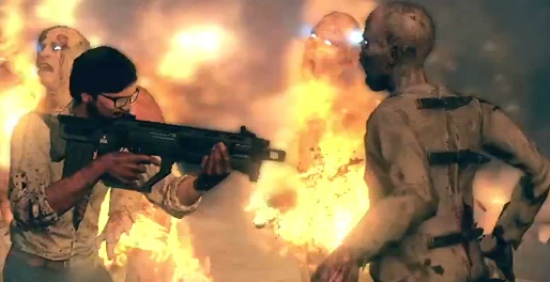
Okay, this pic's not from MW3, but it looks cool, alright?

You know what makes the zombies concept so fun? Knowing the zombies have to rush in hordes to cover the distance between them and their survivors for the kill. Having ranged killing potential is a staple of survivors. Not zombies. Giving zombies this power would be like giving survivors a Commando perk. Melee-range killing potential belongs with the zombies, not the survivors. The fun is in guns versus melee - zombies compensating for their lacking range with high mobility and power in numbers.

This doesn't make survivors overpowered. Did you read what I said? High mobility. I'm not talking about the pathetic speed boost they have in MW3's Infection as we know it. I mean, a 20% step up from where they currently stand. This makes it fun to be a zombie, blazing across the map quickly and making death easier to contend with, knowing each death isn't met with a 30-second marathon through corridors just to be camp-fucked by a cluster of survivors who won't go down. The tactical strain of surviving is relieved with the fun of flying into a room and tearing survivors apart faster than they can react or keep their irons or reticules ahead of you. Think about that, the bearing on reaction times and the ammo wasted trying to hit a quick-moving target. Before long, the survivors deplete and can only resort to knifing.

"What about playing on Dome up on the balcony with only the two ladders?" The survivors deplete their ammo eventually, although I feel the USP alone would be better-suited for that map than equipping survivors with full-blown machine guns and shit when zombies have ladders to contend with. There's a thought... Different weapons suited for different maps. Weaker weapons, I'll add. Something the skillbies can wield to great effect while giving the zombies a chance against the weaker links.

"but tht jus encurredges campin n00b servivers" If you're asking me this, you don't even understand the concept of Infection.

"You're just a noob who can't dodge throwing knives. Do us all a favor and do private match instead." This is probably the most vibrant argument pro-TK Infectionists use. It sounds legit on paper, because as we all know, MW3 is a completely adult game requiring true execution of tactically-prepared skill, right? That must be why zombies repeatedly tac-insert on the same spot and spam knives from a relatively safe distance, eventually getting lucky hits, often without even actually hitting their targets, because that's totally sk1lled, dud3. Get real, half the time you can't even see the knife coming. I'd find it more acceptable if the knife downed you, and teammates had to waste time picking you back up or you'd turn on the spot and infect them behind their backs. Wouldn't that make more sense? Nope - it was more logical to have a parlor knife to the foot drop you instantly, but a fucking Barrett .50 to take two shots to the chest for the same effect.

"What does this have to do with MW3 Infection?" E'rrything. The zombies-vs.-survivors concept was meant to be captured in this playlist. They got it alright because they didn't get it all-right... Nah, actually, MW3's Infection is infectiously bad, like the rest of the game. Yeah, there's a rush the first few matches you play, then you get used to being killed by random-ass knives pitched across the map and suddenly it's not a rush anymore because it's all luck and doesn't feel like you're fighting zombies, but ninjas, rather. Might as well give them guns too.

I spent about ten minutes looking around on forums to see what others had to say about TKs in Infection, and I guess I'm not too surprised how close-minded CoD's 12-year-old fanbase is. It's usually a one-sided, close-minded argument on everything right with TKs with complete disregard for everything wrong with them, which sounds like IW fanboyism.

Really IW, it's over, give up... You can't make games anymore and neither can Treyarch. Both of you need to move on to making Nintendo platformers, where 'same song and dance' is acceptable twenty-some years after the original.